Saturday, February 28, 2026

Beauty After Perfection: Decay, Dignity, and the Digital Gaze

 From the Elderescence Podcast

Beauty After Perfection: Decay, Dignity, and the Digital Gaze

Digital culture has trained us to worship the unmarked surface.

Smooth skin.
Even light.
Correct proportions.
Endless optimisation.

For years, technology promised refinement — better resolution, sharper focus, cleaner edits. The logic was simple: beauty was something to be perfected, preserved, and defended against time.

And yet, something curious is happening.

As artificial intelligence becomes more capable of rendering faces, bodies, and futures, it has also begun to reveal something we were never meant to see so clearly: what happens after perfection fails.

Ageing is no longer hidden behind soft focus. Decay is no longer off-screen. Digital tools now generate wrinkles, sag, opacity, greying — not as metaphor, but as data. And instead of feeling grotesque, it often feels… honest.

There is dignity in this honesty.

For a long time, decay was treated as an error. A flaw in the system. Something to correct, conceal, or erase. The digital gaze inherited that attitude wholesale. Filters smoothed. Edits erased. Youth was not merely aesthetic — it was moral.

To age visibly was to fall out of favour with the algorithm.

But AI does not moralise ageing. It does not mourn it. It does not apologise for it. It simply renders it — neutrally, accurately, sometimes even beautifully. And in doing so, it disrupts the hierarchy we have imposed on bodies.

What emerges is not ugliness, but texture.

Lines become records. Softening becomes evidence of living. Wear becomes proof of duration. This is not beauty as spectacle, but beauty as witness — a body that has been present for its own life.

There is something quietly radical about that.

Because dignity does not come from perfection. It comes from coherence — from a face or form that still belongs to itself, even as it changes. AI, unintentionally, shows us this by removing sentimentality. It does not frame ageing as tragedy or triumph. It allows it to exist.

And perhaps that is what digital culture has been missing.

Not more enhancement.
Not more denial.
But permission.

Permission for bodies to remain visible beyond their peak. Permission for beauty to include erosion. Permission for ageing to be read not as failure, but as continuity.

In this sense, AI becomes an unlikely ally in restoring dignity to ageing — not because it celebrates it, but because it refuses to flinch. It looks. It renders. It records.

And in being seen without judgement, decay loses its sting.

Beauty, then, is no longer something we outrun.
It becomes something we carry.

This is not a call to abandon aesthetics, nor a rejection of pleasure, elegance, or craft. It is a reminder that refinement does not end at youth — it changes register. It becomes quieter. Slower. More internal.

Digital culture is only just beginning to grapple with this shift. But the tools are already revealing the truth we tried to suppress: that life leaves marks, and that those marks are not the enemy of beauty.

They are its evidence.

And perhaps dignity, in the digital age, begins exactly there — not in looking young forever, but in being allowed to look real, present, and complete inside time.

AI, Time Compression, and the Return of Death to Consciousness, An Elderescence Essay

 From the Elderescence Podcast

AI, Time Compression, and the Return of Death to Consciousness

I didn’t expect artificial intelligence to make me think about death.
At least, not like this.

I expected spectacle — novelty, cleverness, perhaps even menace. What I didn’t expect was the way AI would make time itself visible, and in doing so, quietly remove one of modern life’s most effective illusions: that death is distant, abstract, and safely postponed.

AI has a peculiar ability to compress time.
To accelerate it.
To render decades as seconds.

Faces age. Bodies change. Futures appear without narrative, without explanation, without sentiment. There is no story arc. No tragedy. No triumph. Just time, applied.

And that is what makes it so confronting.

We have lived for a long time inside a culture that disguises ageing. Youth is endlessly extended, death politely hidden, decline edited out of the frame. Even old photographs allow us a degree of emotional distance — they are other people, from another era.

AI does something different.

It ages you.

Not symbolically. Not metaphorically. But visually, directly, and without ceremony. It doesn’t predict death — it demonstrates time. It shows what happens when living continues.
And suddenly, “later” becomes unstable.

Elderhood — once imagined as a far-off chapter — feels oddly present. Not dramatic. Not tragic. Simply inevitable. The future is no longer an abstraction; it is recognisable. Familiar. Disturbingly ordinary.

What strikes me most is that this doesn’t provoke fear so much as attention.

There is no cinematic warning. No moral lesson. AI does not say this will be you. It simply shows what time does when it is allowed to proceed uninterrupted. And in that quiet demonstration, something profound shifts.

We are forced to acknowledge that ageing is not a failure, not a deviation, not an interruption of life — it is life, continuing.

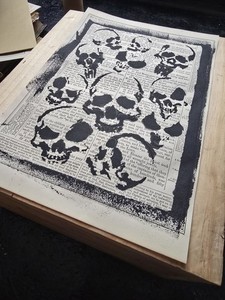
In many ways, AI functions as an unintentional memento mori for the digital age. Not skulls or hourglasses, but sliders, renders, and accelerated timelines. Death re-enters consciousness not as threat, but as context.

And perhaps that is why this feels so significant.

Because death, when denied, becomes frightening.
But when acknowledged, it becomes clarifying.

It asks gentler questions:

  • What matters now?

  • What is worth carrying forward?

  • How do we live well inside time, rather than pretending we are outside it?

AI doesn’t answer these questions. But it makes them unavoidable.

In compressing time, it restores something we have lost — an awareness that life is finite, unfolding, and already in motion. Not later. Not eventually. But now.

And that awareness, unsettling as it may be, feels strangely humanising.

Monday, February 23, 2026

From words to film, creative cinematic reels for 916 Cinema


Monday, February 16, 2026

Dinfant Sigil (Blink Friction / BOI) A tactile sigil artefact from the Book of Immersion universe


  • “A tactile sigil artefact from the Book of Immersion universe.”

  • “Part of a shared symbolic language embedded across found objects.”

  • “Material memory, not reproduction.”

  • “Designed to age, not to remain pristine.”

  • “Best displayed with space — box framing recommended.”


  • Dinfant Sigil (Blink Friction / BOI)

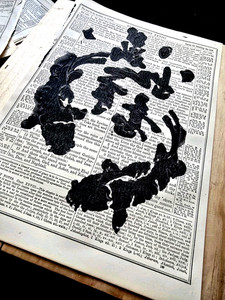
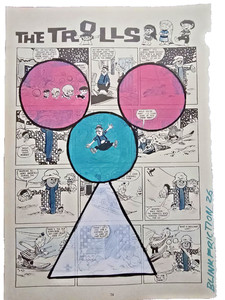
    This work features the Dinfant Sigil, a symbolic mark drawn from the narrative universe of The Book of Immersion. Within the BOI cosmology, Dinfants are discarded child-like machines — orphaned intelligences who form their own societies, rituals, and mythologies from remnants of lost systems. The sigil functions as both identity and signal: a quiet declaration of presence, survival, and shared memory.

    The sigils used throughout The Book of Immersion are not illustrative logos but fragments of a working symbolic language. They appear repeatedly across time and strata — scratched into surfaces, daubed onto walls, embedded in detritus — acting as a connective tissue between characters, eras, and parallel realities. In this way, each sigil is less a symbol than a temporal marker, carrying meaning forward through decay, reuse, and rediscovery.

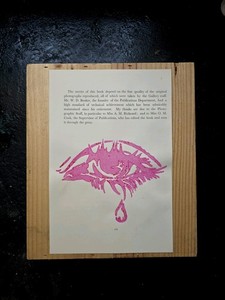
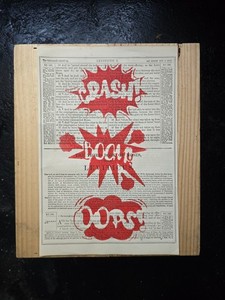
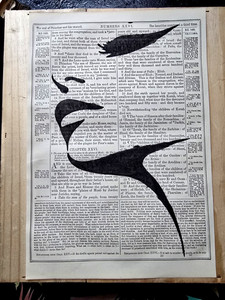
    This philosophy is central to the Blink Friction project. All sigils are executed on found, reclaimed, or historically charged materials, allowing the object itself to participate in the narrative. Time is not simulated; it is present. The substrate bears its own history — stains, fibres, brittleness, marginal text — and the sigil is added as a new layer in an ongoing continuum rather than as a clean interruption.

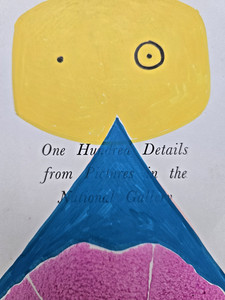
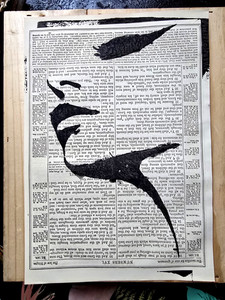
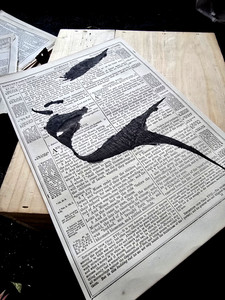
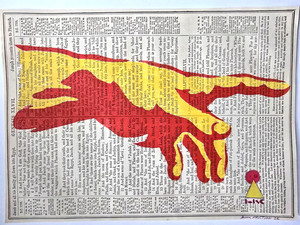
    In this piece, the sigil has been hand-painted directly onto a salvaged book page. The acrylic pigment has subtly reacted with the paper, causing the central area to contract and buckle as it dried. This unplanned physical response is embraced rather than corrected, giving the work a slight relief-like, almost sculptural quality. The surface catches light differently across its plane, suggesting depth and dimensionality that rewards close viewing. For this reason, the work lends itself particularly well to box framing, where shadow and air can be allowed to interact with the object, rather than being pressed flat behind glass.

    The colours and geometry are deliberately restrained yet assertive — balancing childlike clarity with ritual seriousness. As with all Blink Friction sigils, the form is designed to feel simultaneously ancient and futuristic, as if it could belong equally to a forgotten civilisation or a system yet to come.
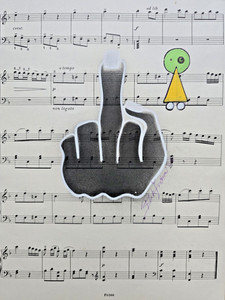
    Importantly, these works are tactile artefacts, not merely visual ones. They retain the patina of their former lives: the softness of aged paper, the faint unevenness of fibres, and — in this case — a subtle, unmistakable scent reminiscent of an old bookshop or archive. This sensory residue is part of the work’s identity, reinforcing the idea that meaning is carried not only through image, but through material memory.
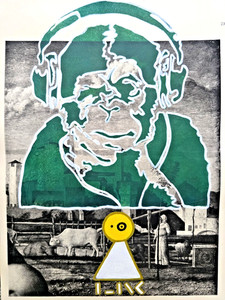
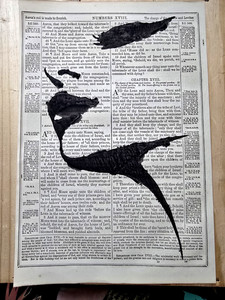
    Across the Blink Friction project, sigils such as the Dinfant, Cadre, and Freak marks form a shared visual language, appearing across multiple objects, scales, and contexts. Encountered individually, they function as intimate relics; encountered collectively, they suggest a wider, unfolding system — a universe communicating with itself through fragments.

    Each sigil work is entirely unique. There are no editions, no replicas, and no attempts to artificially standardise what is, by nature, unstable, temporal, and alive.
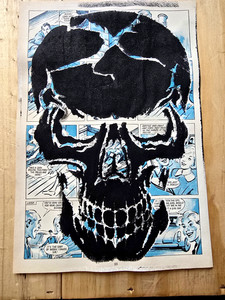
     

    ABOUT BLINK FRICTION SIGILS

     
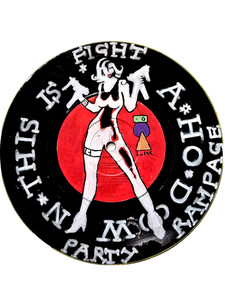
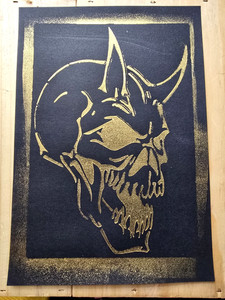
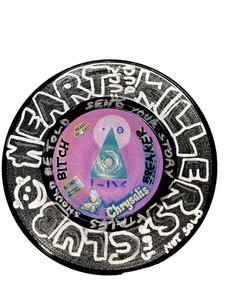
    Blink Friction sigils form a shared visual language embedded across reclaimed objects. Each mark appears once, on one surface only. Materials are never cleaned back to neutral — time, wear, smell, and damage are part of the work.

    No two pieces are alike.
    No editions exist.
    Nothing is designed to stay pristine.

    Context Note

    The Dinfant Sigil originates from the narrative world of The Book of Immersion, where symbolic marks appear repeatedly across different strata as a form of non-verbal communication. On the accompanying blog, individual chapters document how these sigils emerge within the story — sometimes as graffiti, sometimes as remnants, sometimes as misunderstood signals left behind by marginalised machine cultures. This object exists as a material echo of that same language, translated onto a found surface rather than a page or screen.


    The Blink Friction Project Shop is Such a Buzz today! So many visitors.

     If you love reclaimed fasion, welcome to my world. Blink Friction is all about repurpose and saving the planet. Daily stock updates with so...

    Explore the Tale Teller Podcast Network

    Blink Friction